![[personal profile]](https://www.dreamwidth.org/img/silk/identity/user.png) drplacebo
drplaceboIt's Forgotten Masterpiece Friday!
Abu Bakr Khairat (1910-1963) was part of the first generation of Egyptian composers in the Western idiom. Until the last four years of his life, he was purely an amateur composer; he is best known today not as a composer but as one of the Middle East's leading modern architects and the designer of numerous buildings in downtown Cairo and other Egyptian cities. His most important architectural work was the Academy of Arts complex in Cairo; only after its completion in 1959 did Khairat retire from architecture to co-found the Cairo Conservatoire and serve as its first dean.
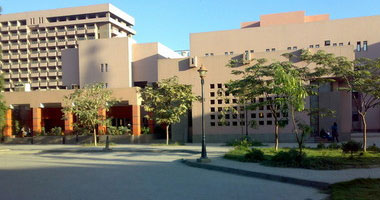

Two of Khairat's architectural works: Academy of Arts complex (left), Mobil Oil building (right)
Khairat learned to play the piano and violin as a child, but as his father was opposed to him making music a career, he set aside his musical pursuits to study engineering at Cairo University. He graduated first in his class in 1930, worked briefly for the Public Works Ministry, and then went to Paris for graduate studies in architecture in 1931. Once in France and out of his father's sight, he resumed his musical activities with private lessons in composition. After returning to Egypt in 1935, he composed as a hobby while working as an architect for more than two decades. He was the first notable Egyptian composer to focus on orchestral works; his three symphonies were the second, third, and fourth composed in Egypt.
Khairat's second symphony, his "Folk Symphony," was composed in 1955 and was somewhat of a response to European Orientalism. After seeing a performance of Verdi's Aida, Khairat debated with some of his friends whether it was possible to compose a large-scale work in the Western tradition while remaining true to Arab musical sources. His friends argued that Arab folk music was not suited to extended musical forms; Khairat was inspired to compose this symphony to prove the opposite. The symphony is in four movements. The first movement, brief but dramatic, serves mainly as an introduction to the symphony as a whole. The second movement is the first to draw directly from Egyptian folk music; although the melodies are original, the fast second theme is based on the style of music that would accompany the "tahtib," a traditional stick dance that resembles mock combat. The third movement, ostensibly a scherzo but a rather leisurely one, portrays a wedding procession, with rhythmic figures taken from several wedding dances from the Alexandria region. The fourth movement, which is almost half of the symphony's entire length, is a programmatic rondo that depicts the flow of the Nile from Lake Victoria to the Mediterranean.
Movements:
I. Allegro moderato
II. Adagio (4:34)
III. Scherzo (8:40)
IV. Finale (15:51)
Abu Bakr Khairat (1910-1963) was part of the first generation of Egyptian composers in the Western idiom. Until the last four years of his life, he was purely an amateur composer; he is best known today not as a composer but as one of the Middle East's leading modern architects and the designer of numerous buildings in downtown Cairo and other Egyptian cities. His most important architectural work was the Academy of Arts complex in Cairo; only after its completion in 1959 did Khairat retire from architecture to co-found the Cairo Conservatoire and serve as its first dean.
Two of Khairat's architectural works: Academy of Arts complex (left), Mobil Oil building (right)
Khairat learned to play the piano and violin as a child, but as his father was opposed to him making music a career, he set aside his musical pursuits to study engineering at Cairo University. He graduated first in his class in 1930, worked briefly for the Public Works Ministry, and then went to Paris for graduate studies in architecture in 1931. Once in France and out of his father's sight, he resumed his musical activities with private lessons in composition. After returning to Egypt in 1935, he composed as a hobby while working as an architect for more than two decades. He was the first notable Egyptian composer to focus on orchestral works; his three symphonies were the second, third, and fourth composed in Egypt.
Khairat's second symphony, his "Folk Symphony," was composed in 1955 and was somewhat of a response to European Orientalism. After seeing a performance of Verdi's Aida, Khairat debated with some of his friends whether it was possible to compose a large-scale work in the Western tradition while remaining true to Arab musical sources. His friends argued that Arab folk music was not suited to extended musical forms; Khairat was inspired to compose this symphony to prove the opposite. The symphony is in four movements. The first movement, brief but dramatic, serves mainly as an introduction to the symphony as a whole. The second movement is the first to draw directly from Egyptian folk music; although the melodies are original, the fast second theme is based on the style of music that would accompany the "tahtib," a traditional stick dance that resembles mock combat. The third movement, ostensibly a scherzo but a rather leisurely one, portrays a wedding procession, with rhythmic figures taken from several wedding dances from the Alexandria region. The fourth movement, which is almost half of the symphony's entire length, is a programmatic rondo that depicts the flow of the Nile from Lake Victoria to the Mediterranean.
Movements:
I. Allegro moderato
II. Adagio (4:34)
III. Scherzo (8:40)
IV. Finale (15:51)